Finding Pictures - A real thriller.

FBW – German Film Rating BoardHighest rating: “Especially Valuable”Read the jury statement (German)
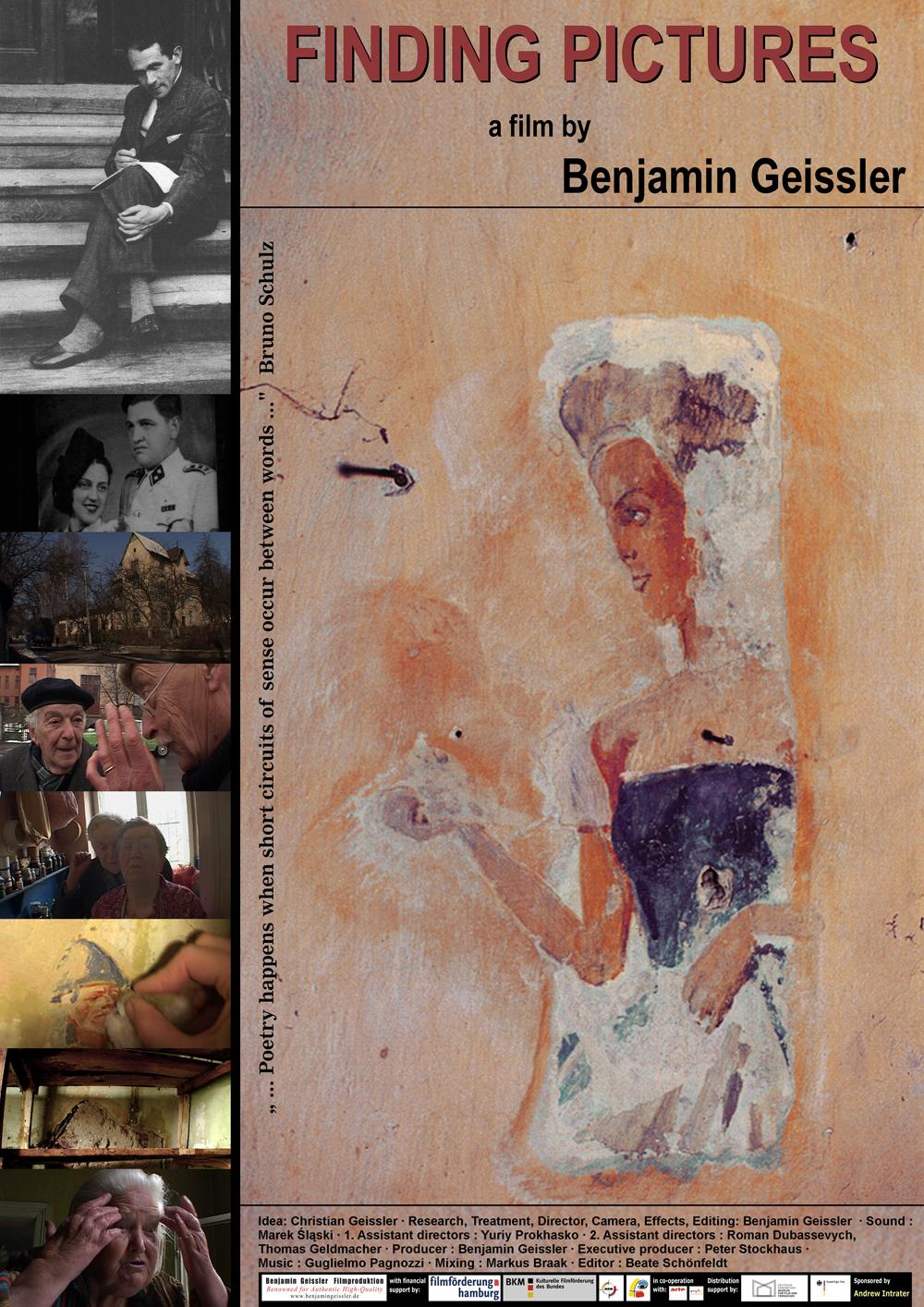
FINDING PICTURES
Born an Austrian, lived as a Pole, and died as a Jew.
Bruno Schulz, the internationally acclaimed Polish-Jewish writer and painter, created murals for the children of Viennese SS officer Felix Landau in 1941–42, under the terror of German occupation, hoping thereby to save his life.
On November 19, 1942, he was shot dead by an SS man. Despite extensive searches after the war, his murals remained missing.
On February 9, 2001, Benjamin Geissler’s film crew rediscovered the long-lost paintings in Drohobych, Ukraine. The camera captured this historic moment.
Just three months later, however, employees of the Israeli Holocaust memorial Yad Vashem secretly removed parts of the murals from the walls and illegally transported them to Israel.
The sensational rediscovery became an international scandal. Competing claims of ownership, assertions of moral authority and political interests collided over the legacy of an artist murdered in the Holocaust. The role of Ukrainian authorities and their possible susceptibility to corruption also came under scrutiny.
“Like the best detective novels, FINDING PICTURES sets out in search of a truth.”
Who owns Bruno Schulz’s last murals?
Yad Vashem claims a moral right to safeguard them. Ukrainian and Polish voices speak of a crime. What part do power, money and political influence play?
And what do Jewish people in Drohobych and Israel have to say?
FINDING PICTURES follows the traces of Bruno Schulz and the memories of people who still knew his world. Historical testimonies, personal destinies, unexpected encounters and unrepeatable footage form a layered, poetic mosaic in which the past becomes unsettlingly present.
“An illuminating, gripping film about the presence of the past.”
A film about the power of images, the pain of memory – and the question of who may tell, preserve or lay claim to history.
What happened in Drohobych goes far beyond a dispute over a work of art. The film shows how history, remembrance and cultural heritage can be appropriated to serve political and moral claims to power – mechanisms that continue to be used to justify violence and war.
Back to top ↑BACKGROUND
“The picture is destroyed, and nobody will know the whole picture.”
Benjamin Geissler – “Quote of the Day”, The New York Times – Today's Headlines, June 20, 2001
The discovery of the murals and their subsequent removal sparked an international controversy that went far beyond the question of their rightful ownership.
For Benjamin Geissler, something more fundamental was at stake from the outset: the artistic legacy of a person whose life and work cannot be reduced either to his Jewish origins or to his Polish identity.
“For me it is very tragic to see Bruno Schulz only as a Jewish victim or only as a Polish writer. He is simply Bruno Schulz, and this is a violent posthumous attack on him.”
The Picture Chamber of Bruno Schulz
The murals by Bruno Schulz, discovered by Benjamin Geissler in 2001, are extraordinary surviving testimonies to an artistic life violently cut short by Nazi persecution.
The history of the paintings is also a history of damage, rediscovery and separation. Today, fragments of the murals are located in Israel and Ukraine. As a result, the work can no longer be experienced in its original spatial and artistic composition at the site where it was created.
Through The Picture Chamber of Bruno Schulz, Benjamin Geissler seeks to reunite virtually the fragments now dispersed between Israel and Ukraine.
The digital reconstruction brings together all surviving fragments of the murals, now dispersed between Israel and Ukraine, at their original scale and in their original spatial and artistic arrangement, making the work visible and accessible worldwide in a compelling way – across geographical and political boundaries.
Lost Pictures ∞ Lost Memory?
What happens to memory when images disappear, are destroyed or are removed from their original context?
This question connects FINDING PICTURES with Benjamin Geissler’s independent documentary Lost Pictures ∞ Lost Memory?. While FINDING PICTURES documents the discovery of Bruno Schulz’s murals and their history, Lost Pictures ∞ Lost Memory? broadens the exploration of images, memory and historical responsibility through further personal and social perspectives.
Discover the film: Lost Pictures ∞ Lost Memory?
Back to top ↑THE PEOPLE BEHIND THE STORY
In 1960, fifteen years after the end of the Second World War, the writer Christian Geissler broke the silence surrounding the guilt of the fathers in postwar German society with his widely acclaimed debut novel The Sins of the Fathers (original German title: Anfrage).
Four decades later, he and his son Benjamin set out in search of the lost murals of Bruno Schulz – a writer whose work places the relationship between father and son at its very heart.
Their journey brings them face to face with extraordinary people: former pupils of Schulz, Holocaust survivors, a Nazi hunter and eyewitnesses whose personal memories reveal unexpected connections.
What begins as a search for lost art ultimately brings Christian Geissler back to a question that has haunted him since The Sins of the Fathers: How do sons confront the guilt of their fathers?
Back to top ↑FILMING LOCATIONS
Drohobycz, at the foot of the Carpathian foothills: Once enriched by the oil industry, this town in Eastern Galicia was an important centre of Jewish life and the hometown of the writer and artist Bruno Schulz.
From here, the cinematic search leads to Poland, France, Israel and other parts of Europe – and reaches as far as Australia by telephone.
Encounters with people whose lives were torn apart by war, persecution and displacement connect distant places through a shared past.
Landscapes, cities and personal living spaces themselves become witnesses to a history whose traces reach into the present.
Back to top ↑CREW & PRODUCTION
Original idea: Christian Geissler · Direction, Cinematography, Editing: Benjamin Geissler · Sound: Marek Śląski · Music: Guglielmo Pagnozzi · Sound mixing: Markus Braak · Assistant directors: Yuriy Prokhasko, Roman Dubassevych, Thomas Geldmacher · Production manager: Peter Stockhaus · Commissioning editor: Beate Schönfeldt · Bruno Schulz voiced by: Kevin Fuller · Production: Benjamin Geissler Filmproduktion · Film funding: Filmförderung Hamburg, BKM, Mitteldeutsche Medienförderung, Kulturelle Filmförderung Mecklenburg-Vorpommern · In cooperation with: ARTE / MDR
Back to top ↑FESTIVALS & AWARDS
FBW – highest rating “Especially Valuable”.
Film awards: Grand Prix – Academia Film Olomouc, Czech Republic (2003) · PHOENIX AWARD – Warsaw International Jewish Film Festival (2004) · Audience Award – Der neue Heimatfilm Festival, Freistadt, Austria (2004).
International festival premieres 2002–2003: World premiere New York, Center for Jewish History (November 19, 2002) · Canadian premiere Montreal Jewish Film Festival · Polish premiere and opening film Krakow Film Festival · Swiss premiere Locarno, Semaine de la Critique · German premiere DOK Leipzig · Ukrainian premiere Molodist Kyiv · Czech premiere Academia Film Olomouc.
Further festivals 2004–2009: FEST Belgrade · Warsaw International Jewish Film Festival · Filmkunstfest Schwerin · Leukerbad International Literature Festival · Der neue Heimatfilm Festival, Freistadt · Jewish Eye World Jewish Film Festival, Tel Aviv (competition) · Bruno Schulz Festival Dublin · River Film Fest, Písek.
International special screenings 2003–2013: Harvard University · Lviv University · Lublin University · Toronto / Goethe-Institut · Academy of Arts Berlin · Musée d'art et d'histoire du Judaïsme, Paris · Jewish Culture Centre Krakow · Paideia Stockholm · Humboldt University Berlin · National Yiddish Book Center, Amherst · INALCO / Paris-Sorbonne, International Bruno Schulz Conference (2013), with an academic presentation on the murals and a film screening.
Television broadcasts 2004–2005: ARTE · MDR · TVP1 Poland · ARD Digital.
Personal honour 2012: Honorary distinction from the Judaica Foundation, Krakow, awarded to Benjamin Geissler for his longstanding commitment to preserving the memory of Bruno Schulz and his artistic legacy.
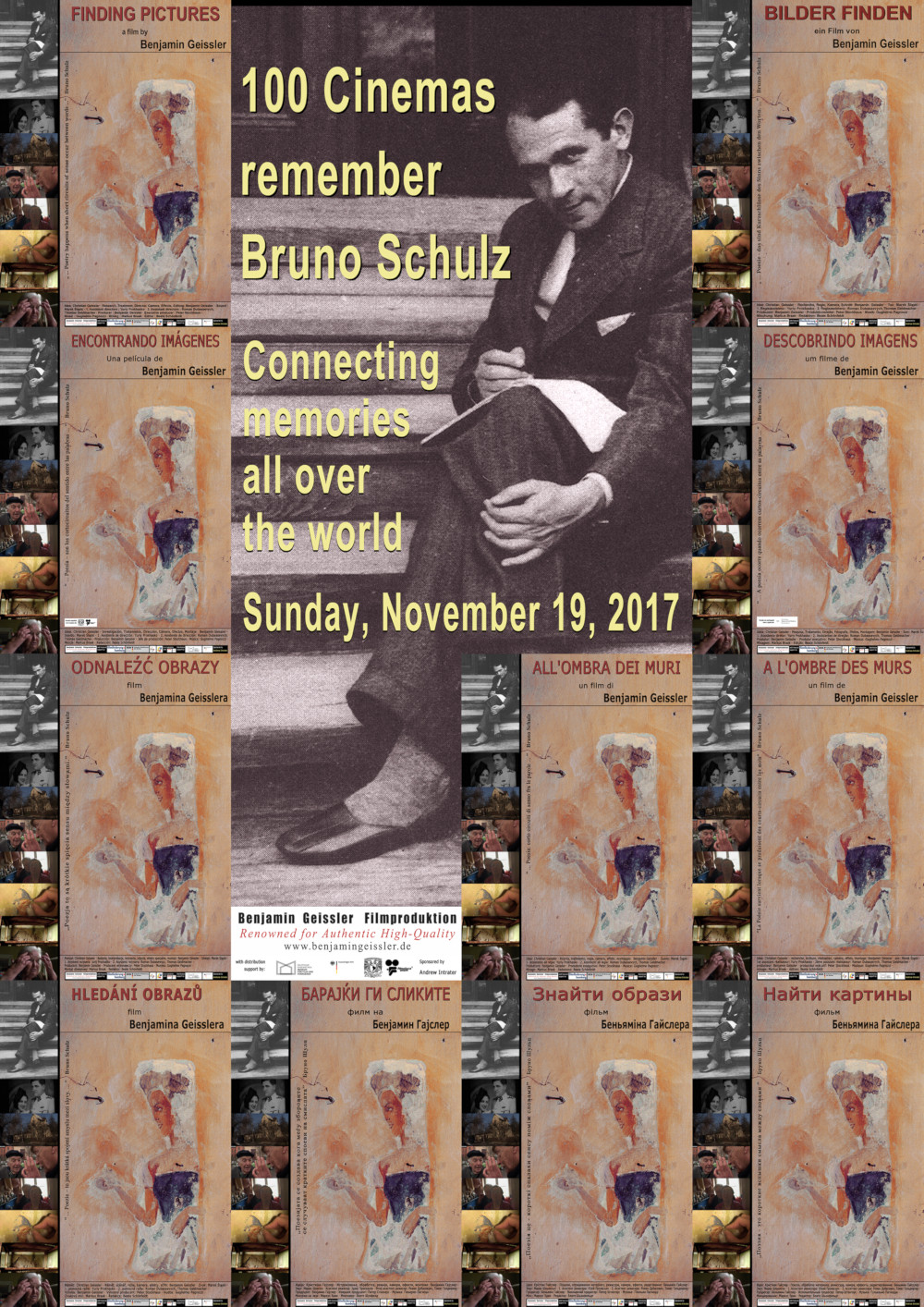
100 CINEMAS REMEMBER BRUNO SCHULZ – WORLDWIDE
International film event commemorating the 75th anniversary of Bruno Schulz’s death, November 19, 2017
From Jerusalem to Rio de Janeiro and Mexico City to Chicago, from Venice to Kraków and Lviv to Moscow: Benjamin Geissler’s documentary FINDING PICTURES was screened in eleven language versions across more than 80 cities in 16 countries.
The initiative, conceived and organised by Benjamin Geissler, brought people together across continents and cultures to remember Bruno Schulz.
Public Screenings and Educational Use
FINDING PICTURES is suitable for public screenings, film festivals, museums, memorial institutions, universities and educational programmes. The documentary offers an introduction to Bruno Schulz, the Jewish cultural history of Galicia, Nazi persecution and contemporary questions surrounding cultural heritage.
Public screening rights and EDU licences are available for cultural events and educational institutions. Screening enquiries and licensing information can be requested through the film page.
Back to top ↑PRESS AND FILM REVIEWS
New York · World premiere on November 19, 2002
The Messianic Poltergeist – a poetic response to the world premiere
Exactly 60 years after the murder of Bruno Schulz, FINDING PICTURES had its world premiere in New York. Among the audience were former pupils of the writer and survivors from Drohobych. In his poem, Valery Oisteanu evokes the moment when people from their youth – even a former lover – are recognised on screen.
The surrealist poet and artist Valery Oisteanu transforms this moving moment into a ghostly return of Bruno Schulz:
“Last night on a full moon in Manhattan
The poltergeist shouted and echoed”
Valery Oisteanu · Romanian-American surrealist poet, artist and art critic · The Messianic Poltergeist to Bruno Schulz · NY Arts Magazine, New York, 2002
Excerpt from the original English poem
Back to top ↑Poland · 2002–2003
“This film combines the sharpness and realism of documentary, the power of historical testimony and the unhurried rhythm of a mythological narrative with references to Bruno Schulz’s literary and visual universe.”
Nawojka Cieślińska-Lobkowicz · Polish art historian, specialist in Nazi-looted art and restitution · Schulz w Ameryce (Schulz in America) · Gazeta Wyborcza, 18.11.2002
Translated from Polish
“Benjamin Geissler’s film FINDING PICTURES is among those rare documentaries that will remain in cultural memory: they not only record important events but also shape them.”
Tadeusz Lubelski · Polish film historian, film critic and professor at Jagiellonian University in Kraków · Co się wydarzyło w Drohobyczu (What Happened in Drohobych? – Finding Pictures) · KINO, Nr. 5/2003
Translated from Polish
Back to top ↑Ukraine · 2003
“There are no superfluous details in this film.”
“Almost every frame invites prolonged contemplation, like an ancient palimpsest in which another, barely perceptible image shines through the visible one.”
“As though someone had secretly watched your surrealist dream and recreated it on screen.”
Natalija Katerynenko · Ukrainian cultural journalist and film critic · Незаконченный поиск знаков Бруно Шульца · Телекритика, 30.10.2003
Translated from Russian
“A wealth of wonderful emotions, bound up with an almost detective-like search and an unexpected ending.”
Mychajlo Brynych · Ukrainian writer, journalist and screenwriter · Забути Шульца · Телекритика, 31.10.2003
Translated from Ukrainian
Back to top ↑Germany · 2004
“A sensitive, perceptive documentary film.”
Reinhard Lüke · German film critic · · filmdienst, Nr. 3/2004
Back to top ↑