Lost Pictures ∞ Lost Memory? - What we forget never lets us go.
FILM & SYNOPSIS
A thousand rooms – a thousand stories.
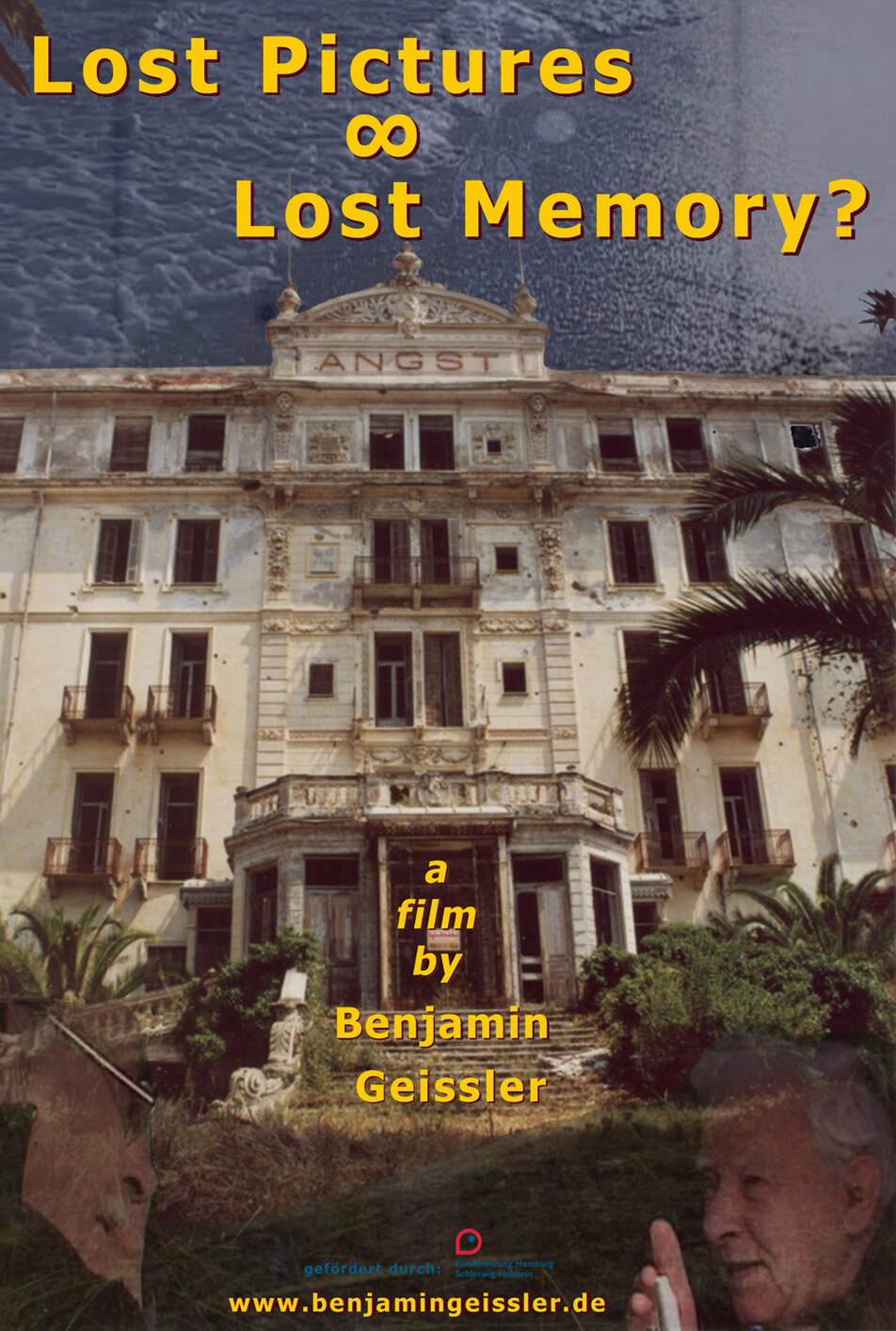
On the Italian Riviera, the abandoned Grand Hotel Angst stands in an overgrown palm garden. Once a luxurious meeting place for international guests, it is now a mysterious labyrinth of faded splendour, dark corridors and rooms steeped in the past.
Here begins an extraordinary journey through time and memory.
A Nazi hunter searches for missing photographs. A writer confronts the silence of post-war society. People speak of persecution, resistance, war and decisions that changed their lives.
What connects their experiences to a Sicilian pastry chef, the psychology of the Mafia or the centres of political power in Europe?
The surprising connections reveal themselves only gradually.
At the Grand Hotel Angst, doors open onto other times and worlds. Images emerge, overlap and disappear. Powerful encounters alternate with music, unexpected humour and poetic moments.
Seemingly unrelated stories form a fascinating mosaic of power, fear, silence and memory. What first appears far apart suddenly comes remarkably close.
Lost Pictures ∞ Lost Memory? is a journey of discovery full of unexpected turns – an extraordinary cinematic experience that questions historical certainties and raises startlingly contemporary questions.
Back to top ↑BACKGROUND
The Grand Hotel Angst – a place beyond time
The abandoned Art Nouveau hotel in Bordighera is the film’s visual centre. Its windows, doors and mirrors become passages into other lives.
The hotel is also a metaphor for human memory. Behind every door may lie another recollection – or a story long kept silent.
“The building is also a metaphor for the mind; the hotel’s many rooms are like small chambers in our brain.”
The art of memory
The film is dedicated to Giordano Bruno and his work on the art of memory, Cantus Circaeus (The Incantation of Circe).
“Indeed, an inaccessible art, I readily admit; but only if one approaches it without a ladder.”
Inspired by Bruno’s art of memory, an intuitive ladder of images, recollections and associations takes shape.
The film brings together experiences and previously unreleased material from two decades of documentary work – from Bussmanns im Wald to Finding Pictures.
Its unusual editing connects people, places and times that at first seem unrelated. New meanings emerge through these connections. The images often tell more than words can explain.
Like an unfamiliar city, the film invites us to explore unknown paths. Every discovery opens up a new perspective.
Back to top ↑THE PEOPLE IN THE FILM
What divides people. What connects them.
A Nazi hunter searching for missing images. A writer for whom silence was never an answer. A musician whose memories keep a lost world alive.
Tuviah Friedman, Christian Geissler and Alfred Schreyer bring experiences that reach far beyond their individual stories. Their voices join those of Ukrainian writer Jurij Andruchowytsch, Shoah survivor and diplomatic interpreter Emmanuel Weintraub, and Cornelia Schmalz-Jacobsen, Mordechai Paldiel and Shalom Lavi.
But the journey also enters worlds where we might expect entirely different questions: that of Sicilian pastry chef and philosopher Corrado Assenza, and of Prof. Girolamo Lo Verso, who examines the hidden mechanisms of the Mafia. Historian Prof. Jacub Honigsman and Shimon Sevor add further perspectives.
What does the art of remembering have to do with the psychology of power? What connects individual decisions to the great upheavals of history?
Their experiences, observations and thoughts form an intricate web of images and stories. Across time and borders, connections emerge that reach far beyond individual lives.
What seems long past proves frighteningly present. And some things we take for granted today suddenly raise entirely new questions.
Back to top ↑FILMING LOCATIONS
Between vanished places and hidden stories
Night-time bazaar passages in Jerusalem. An empty square in the moonlight. In Drohobych, Ukraine, a musician remembers a street that no longer exists. On the Italian Riviera, dark staircases and winding corridors lead through the abandoned Grand Hotel Angst.
The journey crosses Europe and reaches Israel. Yet its locations are more than points on a map: behind doors, façades and seemingly ordinary images, unexpected paths into the past open up.
Places change, disappear or endure. What happened there continues to resonate – sometimes in surprising ways, right into our present.
Back to top ↑CREW & PRODUCTION
Writing, Direction, Cinematography, Editing, Special Effects: Benjamin Geissler · Additional Camera: Giancarlo Pancaldi · Sound: Marek Śląski, Andrea Masciocchi · Music: Guglielmo Pagnozzi, Nino Jvania · Sound Mix: Stephan Konken · Production: Benjamin Geissler Filmproduktion · Film Funding: Filmförderung Hamburg Schleswig-Holstein
Back to top ↑PREMIERE & INTERNATIONAL SCREENINGS
Filmfest Hamburg 2009
World premiere on 29 September 2009 at Metropolis im Savoy during the 17th Filmfest Hamburg.
An accompanying interdisciplinary programme brought together Ukrainian literature and music with Jurij Andruchowytsch, Giordano Bruno’s art of memory, Mafia psychoanalysis with Prof. Girolamo Lo Verso, and the culinary art of Corrado Assenza.
Portugal 2010
On 30 October 2010, the film screened at the Encontros Cinematográficos at the Teatro Municipal da Guarda, followed by a discussion with Benjamin Geissler and Maria Lino.
Back to top ↑PRESS & INTERVIEWS
“This work in progress by Ben Geissler is a complex philosophical meditation on the meaning of the Holocaust, the Fascist mentality, and, in general, the kind of brainwashing that turns people into remorseless killers.”
From the German:
“Giving impulses and preserving ‘diversity’ – that, too, is the guiding principle of filmmaker Benjamin Geissler.”
From the Portuguese:
“Moving between cinematic essay and numerous interviews, associative cuts and intuitive leaps through time, Geissler travels through the worlds of thought of the past century and our young century.”
From the German:
Back to top ↑“It is about memory and experience, silence, concealment and speaking out, nationalism and bureaucracy, as well as fears and compulsions to repeat […]”