EXHIBITIONS
The Picture Chamber of Bruno Schulz
A curatorial masterpiece – Conceived by discoverer and filmmaker Benjamin Geissler
Previous renowned exhibition venues: Berlin, Martin-Gropius-Bau · Luxembourg, Institut Pierre Werner, Centre Culturel de Rencontre Abbaye de Neumünster (CCRN) – Agora · E-Werk Freiburg · Falckenberg Collection of the Deichtorhallen, Hamburg · Gerhart Hauptmann Theater, Zittau
„It is a sensation in cultural history: during the filming of his documentary Finding Pictures, Benjamin Geissler located the long-lost, now world-famous wall paintings of the Jewish writer and painter Bruno Schulz in the western Ukrainian province – a discovery that took the international art world by storm and ignited a global debate on cultural heritage and the politics of memory.“
Experience the dynamics of the exhibitions: click on one of the posters to view an animated visualization of the show.
Or look directly into our Guestbook.
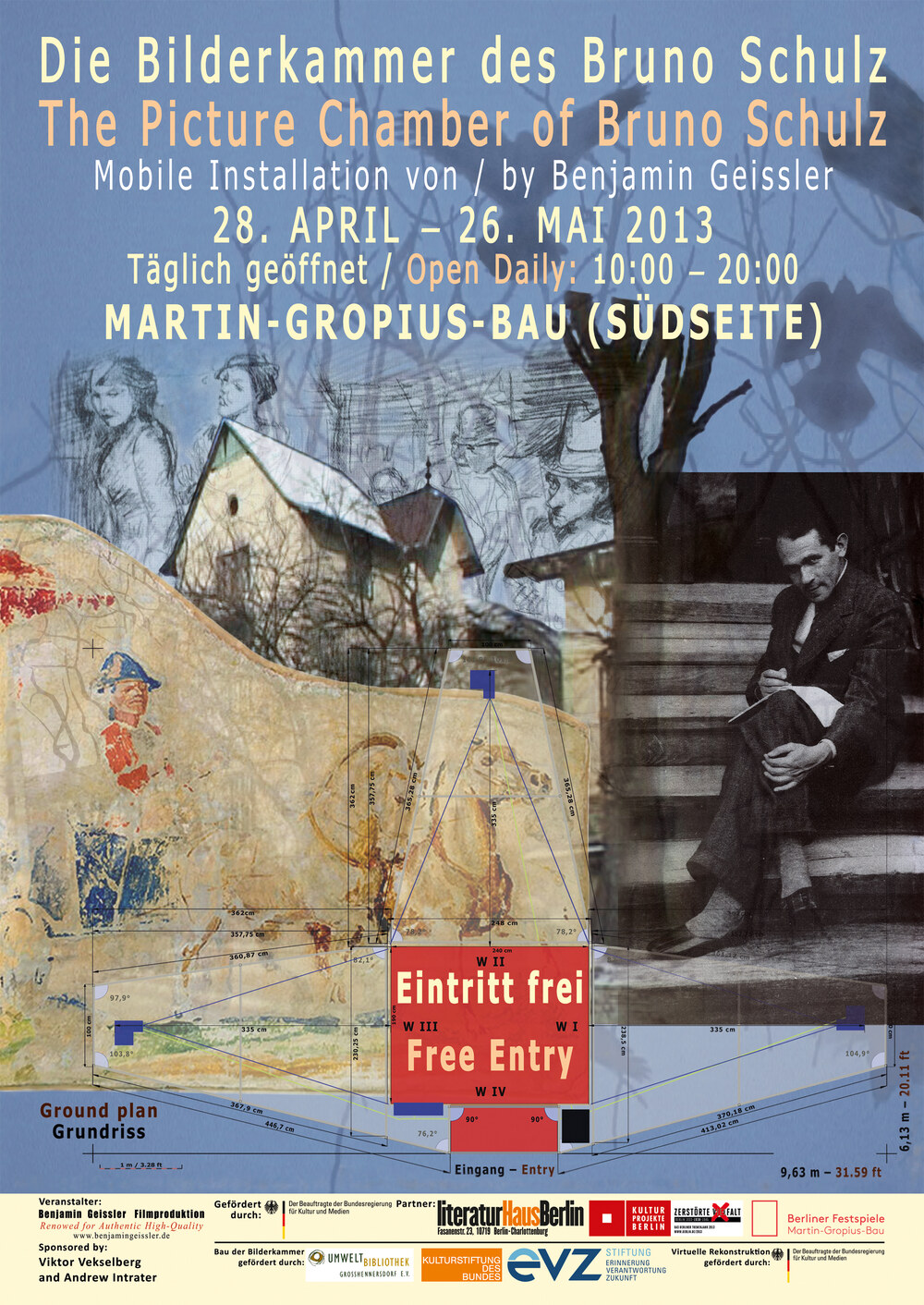
Martin-Gropius-Bau
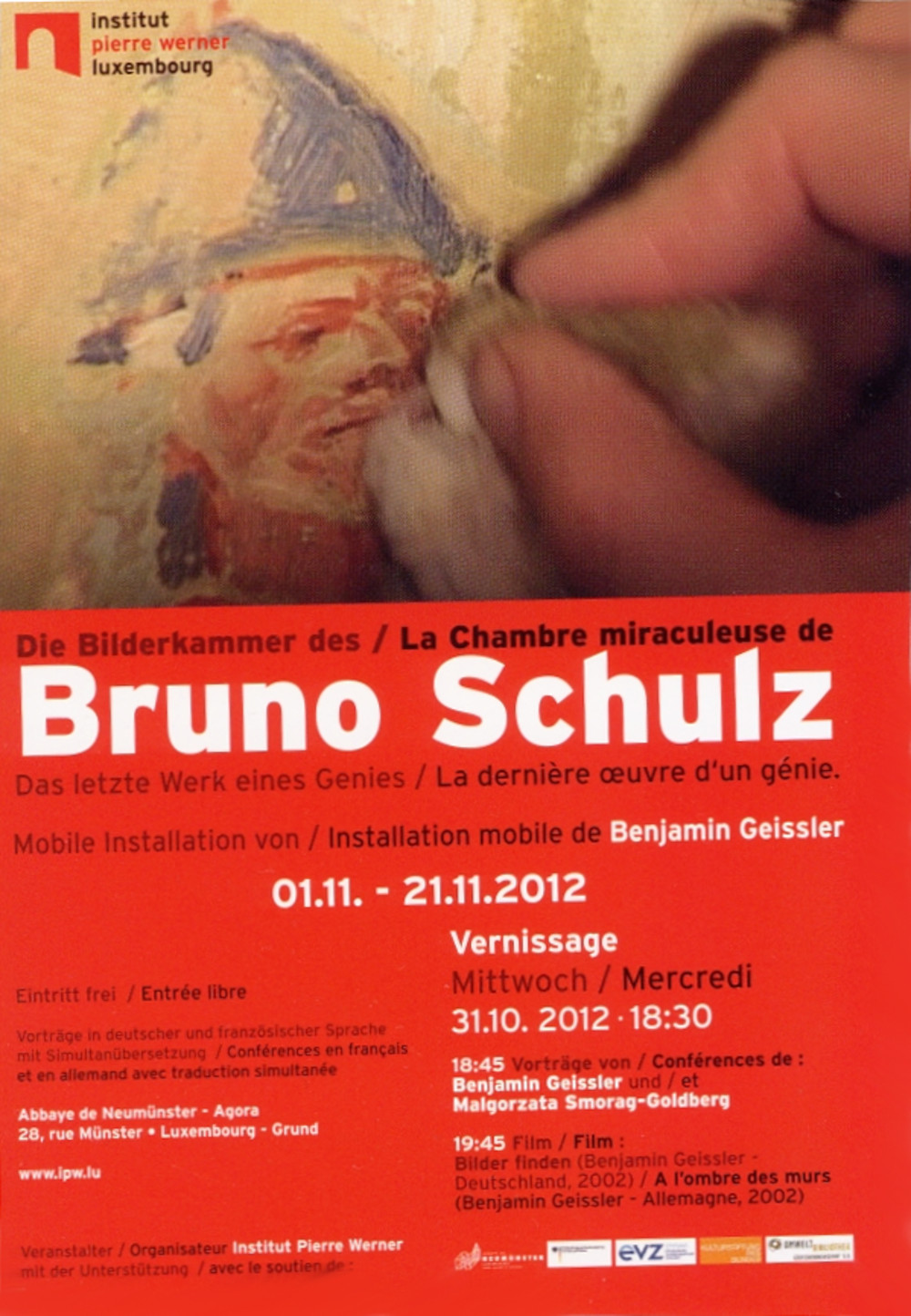
Abbaye de Neumünster
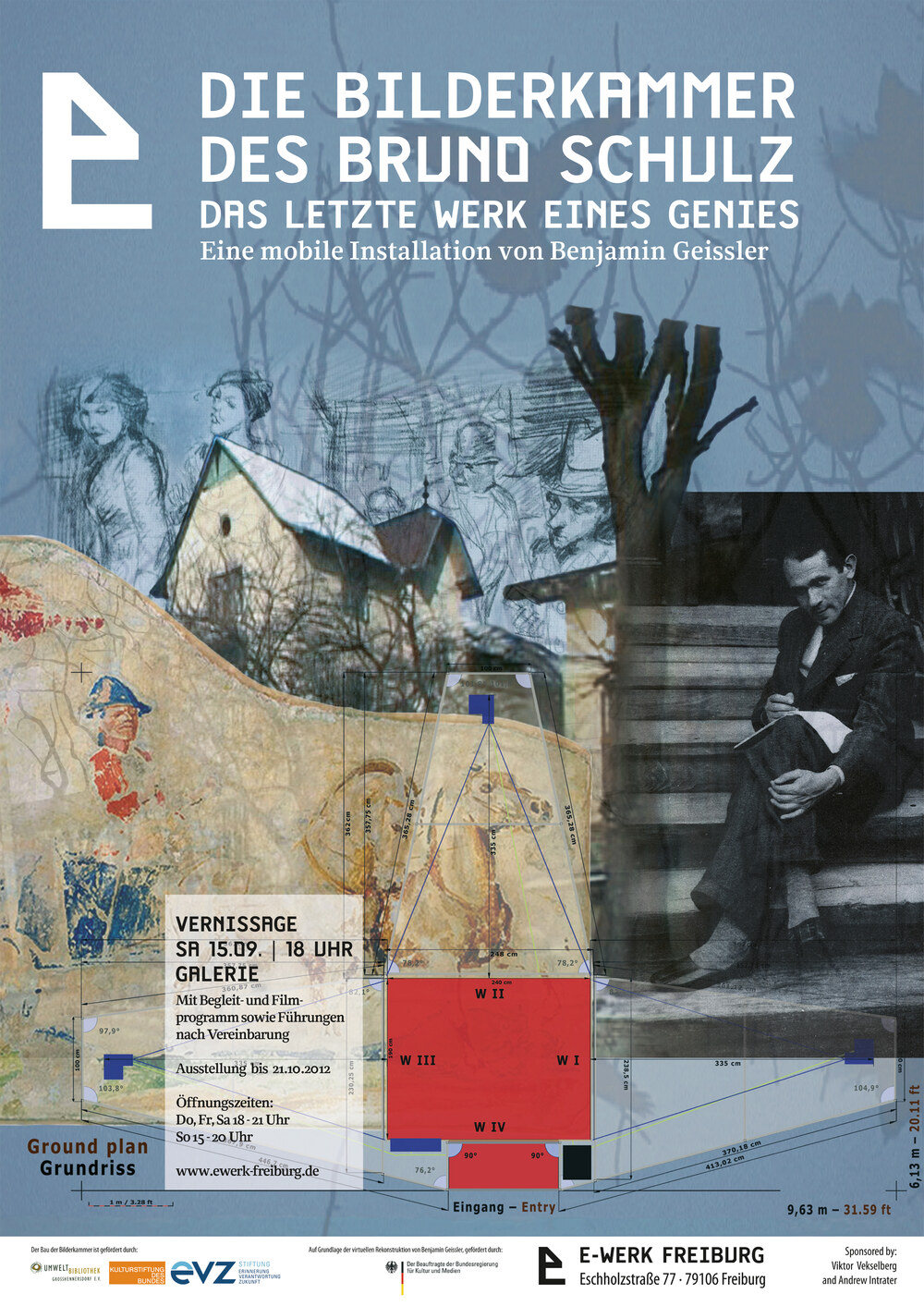
E-Werk
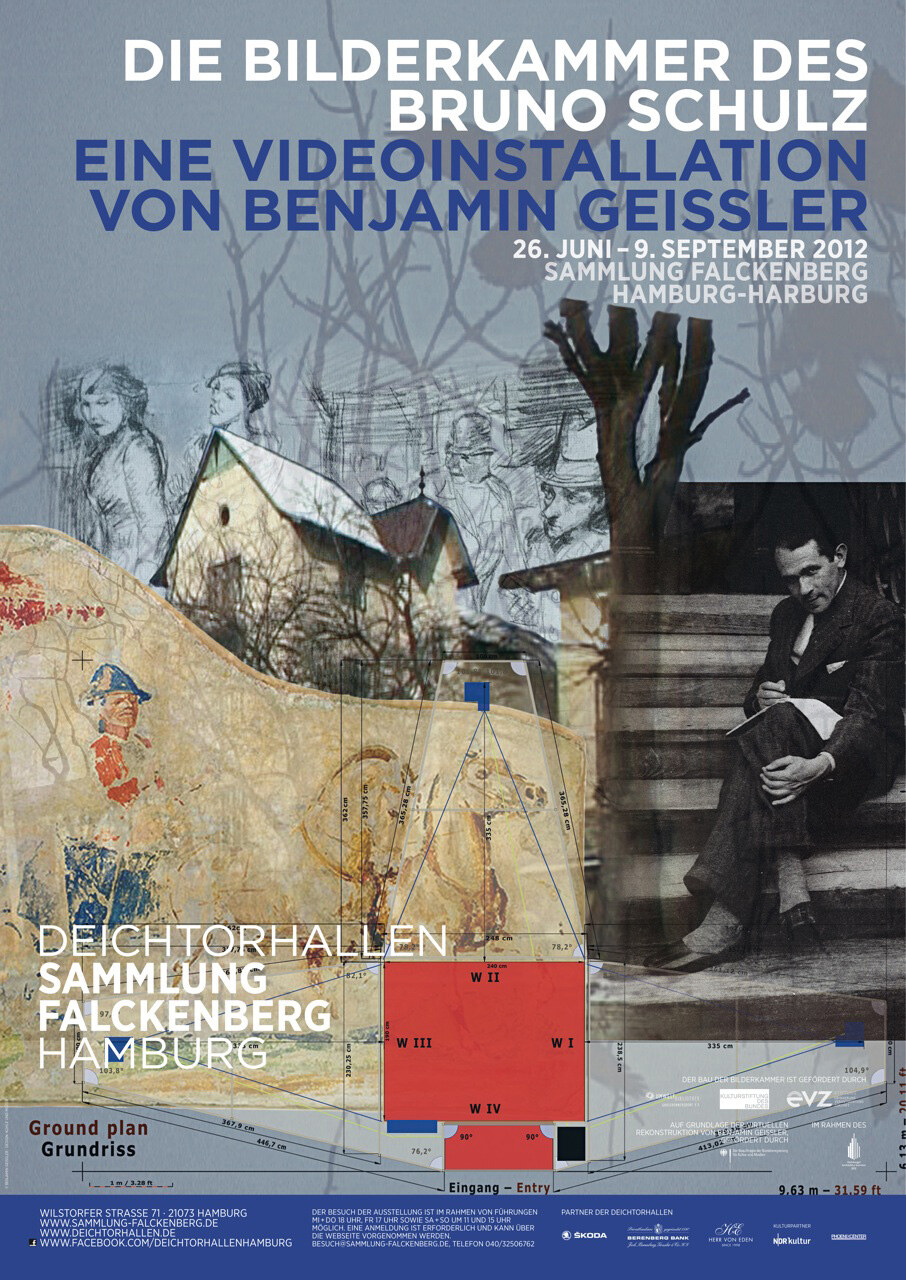
Falckenberg Collection
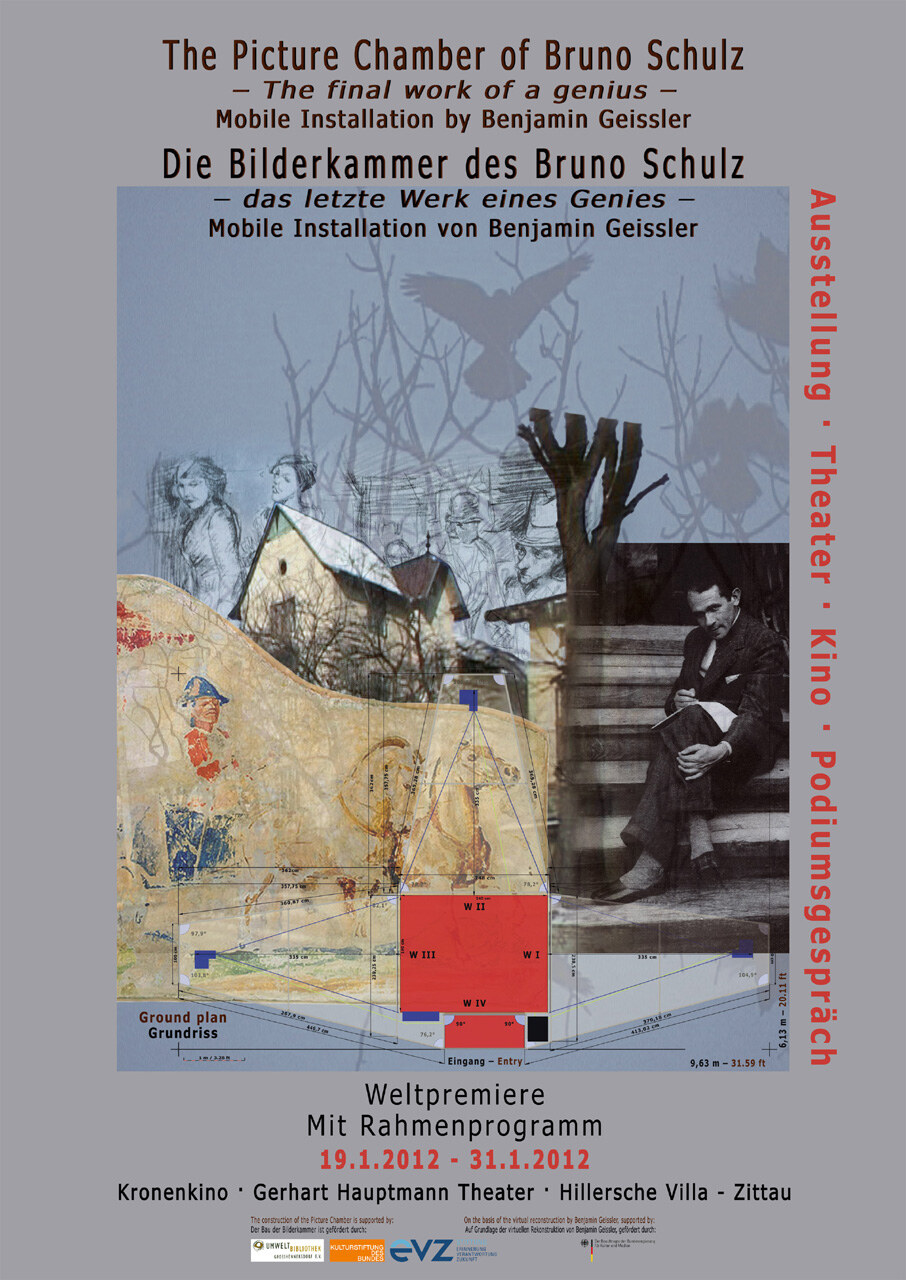
Gerhart Hauptmann Theater

Live panel discussion at the exhibition opening
The Picture Chamber of Bruno Schulz at E-WERK Freiburg
Video documentation in three language versions of the live broadcast between E-WERK Freiburg and the Center for Urban History in Lviv.
In conversation: Jurij Andruchowytsch and Benjamin Geissler. Moderated by: Jurko Prochasko.
International Press Reviews & Quotes
Polish Press Front Pages (prior to the NYT report)
Even before the first article appeared in The New York Times, almost the entire Polish press reported extensively on their front pages over a period of about two weeks on the illegal removal of the frescoes from the Ukrainian provincial town of Drohobych.
The New York Times (Front Page & Arts Section)
„Artwork by Holocaust Victim Is Focus of Dispute“ – The discovery of the lost wall paintings and the international dispute reached the front page of The New York Times in June 2001. The following quote by Benjamin Geissler appeared directly on the front page, with the phrase „The picture is destroyed, and nobody will know the whole picture.“ additionally highlighted as a prominent „Quote of the Day“:
„The double sense of the picture is that he tells the real story of what is going on, but as a fairy tale. [...] The picture is destroyed, and nobody will know the whole picture. For me, it is very tragic to see Bruno Schulz only as a Jewish victim or only as a Polish writer. He is simply Bruno Schulz, and this is a violent postmortem attack against him.“
TIME Magazine
Under the title „Whose Art Is It Anyway?“, TIME Magazine focused on the worldwide controversy surrounding the authorship, the discovery, and the controversial rescue or removal of the frescoes.
Neue Zürcher Zeitung, Feuilleton, February 14, 2012
As an Art Slave to a Murderer – „The Picture Chamber of Bruno Schulz“ – Benjamin Geissler's Labor of Love for a Genius
Panels of black cloth, stretched over scaffolding, conceal video projectors and form three elongated structures that border a walk-in chamber like wings of a building. The chamber is small, measuring not even five square meters, and its darkness is illuminated by interplays of light on the walls, which freeze for moments, fade, and return. It has something magical about it. ...
In Benjamin Geissler's „The Picture Chamber of Bruno Schulz“, the composition now comes to life as a true-to-scale digital 3D projection. Should anyone ever wish to reunite the original frescoes at some point in the future – this installation provides the definitive foundation for it.
JOACHIM GÜNTNER
Süddeutsche Zeitung, Feuilleton, August 27, 2012
Fairy Tales for the Children of a Gestapo Officer
... 70 years after the murder of Bruno Schulz, Geissler's reconstruction of Schulz's forced artistic labor reveals a junction point where fairy tales and massacres, poetry and perversion, freedom and destruction merge into a single, seemingly banal decoration. Bruno Schulz once wrote: „The life of the word consists in its stretching and straining toward a thousand connections.“ These wall paintings perform a similar service. They link the childlike imagination of these motifs with the horror of history and the escapism of literature. To tread these paths – at least in the case of Bruno Schulz's stories – is a very wise decision, even in our peaceful times.
TILL BRIEGLEB
Frankfurter Allgemeine Zeitung, Feuilleton, May 13, 2013
Fairy Tales in the SS Playroom – Reconstructed in Berlin: The Picture Chamber of the Jewish Painter Bruno Schulz
... Benjamin Geissler's installation, which will hopefully be shown many more times, is a moving requiem for a passionately admired artist, a historical journey through time, and a protest against the unilateral appropriation of art.
REGINA MÖNCH
Taide Art Magazine, Finland 4/2013 – Pienen Kuvakamarin pitkä tarina
Small Picture Chamber – Long Story
The Picture Chamber was on display for the first time in Hamburg last year. Most recently, it was shown in the spring at the Martin-Gropius-Bau in Berlin. It is a gem of the art world, hiding more within its interior than it reveals. ...
The original fragments in Israel and Ukraine are incapable of telling the story of the painting. That only happens now in Geissler's video installation. It is not a mere replacement for the destroyed paintings, but an artwork that also tells its own unique history.
LEENA BECKER
The Jewish Journal of Greater L.A., Journalism, June 15, 2013 – The Continuing Mystery of Bruno Schulz
The Continuing Mystery of Bruno Schulz
... Yet, the discovery of the seemingly lost mural is not the end of its mysterious story. Shortly after the initial exposure, representatives of the Yad Vashem Holocaust Memorial removed three fragments and transported them to Israel. The action was claimed to be illegal, since such a procedure is possible only with a special permit from the Ukrainian Ministry of Culture.
The controversy, in which every country claims a major stake in Schulz's heritage, and which was triggered right after the Yad Vashem incident, must of course be viewed against the diverse background of the region, so typical of pre-war Central Europe. For Yad Vashem, Schulz is a Jewish genius and Holocaust victim. For Poland, Bruno is a Polish writer, an innovator of the Polish language and literature, and last but not least, a Polish citizen. For Ukraine, he was a resident of the Ukrainian city of Drohobycz, and that is exactly where the mural was created and found today.
But according to Benjamin Geissler, Schulz's work cannot be separated either metaphorically or literally. The director suggests that Schulz, in his last mural, did not merely depict fairy-tale characters to decorate a nursery. Upon closer inspection, one can unmistakably recognize Felix Landau on his beloved horse, his mistress Gertrud, Schulz's mother and many other hidden images in the figures depicted. Schulz's mural is on its surface a Brothers Grimm fairy tale and a Holocaust story, the story of a personal tragedy on a deeper level, Geissler says. The commissioned work twists into something much more meaningful and personal, an act that is both childlikeness and prophecy, as unique as all of Schulz's art. Because of its messages, the mural cannot be cut apart and can only be viewed in the manner in which it was created, in which every one of its elements is placed in relation to the others. ...
IAN SHULMAN
Luxemburger Tagblatt & regional daily press
Appreciation of the cinematic and artistic treatment as a moving document of the times that brings the memory of the murdered Polish-Jewish writer and painter Bruno Schulz back into the consciousness of the European public.
The Picture Chamber of Bruno Schulz:
Project overview of the mobile installation
- Author: Filmmaker and director Benjamin Geissler.
- Subject: The final artistic work of the renowned Polish-Jewish writer and painter Bruno Schulz. Under German occupation in 1941/42, Schulz was forced to create wall paintings in the children's playroom of a villa occupied by SS-Hauptscharführer Felix Landau in Drohobych (Ukraine).
- Core Concept: A true-to-scale, multimedia mobile installation that reconstructs the destroyed “Picture Chamber”, enabling viewers to experience the complete composition along with all known fragments currently scattered across Israel and Ukraine.
Historical Background
- Bruno Schulz: Born as an Austrian on June 12, 1892, in Drohobych; lived as a Pole; and murdered as a Jew on November 19, 1942, in Drohobych. Celebrated as an outstanding writer of the 20th century (often referred to as the Polish Kafka), whose masterpieces like The Street of Crocodiles and Sanatorium Under the Sign of the Hourglass have been translated into 39 languages.
- The Murders & Discovery: Schulz was shot and killed by the Gestapo on November 19, 1942, during a “wild action” in Drohobych. The wall paintings had fallen into oblivion until Benjamin Geissler rediscovered them on February 9, 2001, while filming his documentary Finding Pictures.
- Controversy and Destruction: In May 2001, representatives of Yad Vashem removed three fragments and transported them to Israel in an illegal, clandestine, and highly controversial operation, severing the integrity of the overall composition. Ukrainian conservators removed five additional fragments in 2002, and further unauthorized damage occurred in June 2001.
Exhibition & Technical Details
- Exhibition Format: A walk-in, true-to-scale wooden floor structure combined with high-resolution digital 3D projections on four walls, cycling through the phases of discovery, destruction, and virtual reconstruction.
- Exhibition Venues (Initial Stations): Zittau, Hamburg (Falckenberg Collection/Deichtorhallen), Freiburg, Luxembourg, and Berlin (Martin-Gropius-Bau).
- Space & Assembly Requirements:
- Minimum room dimensions: 12.23 by 8.73 meters with a ceiling height of 3.65 meters.
- No room darkening required.
- Delivered in 6 flight cases; installation and dismantling each require 2 working days with a 3-person team provided by Benjamin Geissler and a stepladder (3.5 meters working height) provided by the host.
Booking Inquiries & Exhibition Dates
The exhibition is exceptionally well-suited for museums, cultural centers, universities, Goethe-Instituts, and festivals dedicated to European literary and art history, Holocaust remembrance, or innovative documentary formats.
For exhibition collaborations, loan conditions, and scheduling, please contact us directly using the button below.
Inquire about Exhibition