Vincenzo Floridia, or the Last Rose of Noto
Film & Synopsis
What does home mean when it offers little prospect of a future?
After ten years in northern Italy, locomotive driver Vincenzo Floridia returns to his hometown of Noto in southeastern Sicily in 1987. His parents had already emigrated to Australia in search of work, and it was there that Vincenzo was born. They too were eventually drawn back to Sicily.
But is returning really a new beginning? Vincenzo loves his homeland, his friends and the spontaneity of Sicilian life. At the same time, he faces a society marked by a lack of economic prospects, political failures and the power of the Mafia.
Benjamin Geissler accompanies him on journeys across Sicily, at work, with his family and among friends. With humour, openness and unexpected thoughtfulness, they speak of their hopes, disappointments and search for a self-determined life.
The railway links their stories. Yet it too is undergoing profound change: ageing trains, threatened routes and the onset of automation call into question not only jobs but an entire way of life.
A vivid and reflective portrait of Sicily beyond tourist idylls and familiar Mafia clichés. A film about friendship, home and the freedom to remain true to oneself.
Background
What does home mean once you have left it? What draws someone back to a place where beauty and joy coexist with economic uncertainty, social contradictions and silence about uncomfortable truths?
In Vincenzo Floridia, or the Last Rose of Noto, Sicily becomes the setting for a complex search for belonging. The film echoes Elio Vittorini’s novel Conversation in Sicily (Conversazione in Sicilia), in which a return to the island is also an encounter with the past and the contradictions of the present.
Among Noto’s Baroque streets, railway stations and the landscapes of southeastern Sicily, personal memories meet the upheavals of a changing society. Familiar ways of life shift; certainties begin to falter. What remains when circumstances change but the bond with home endures?
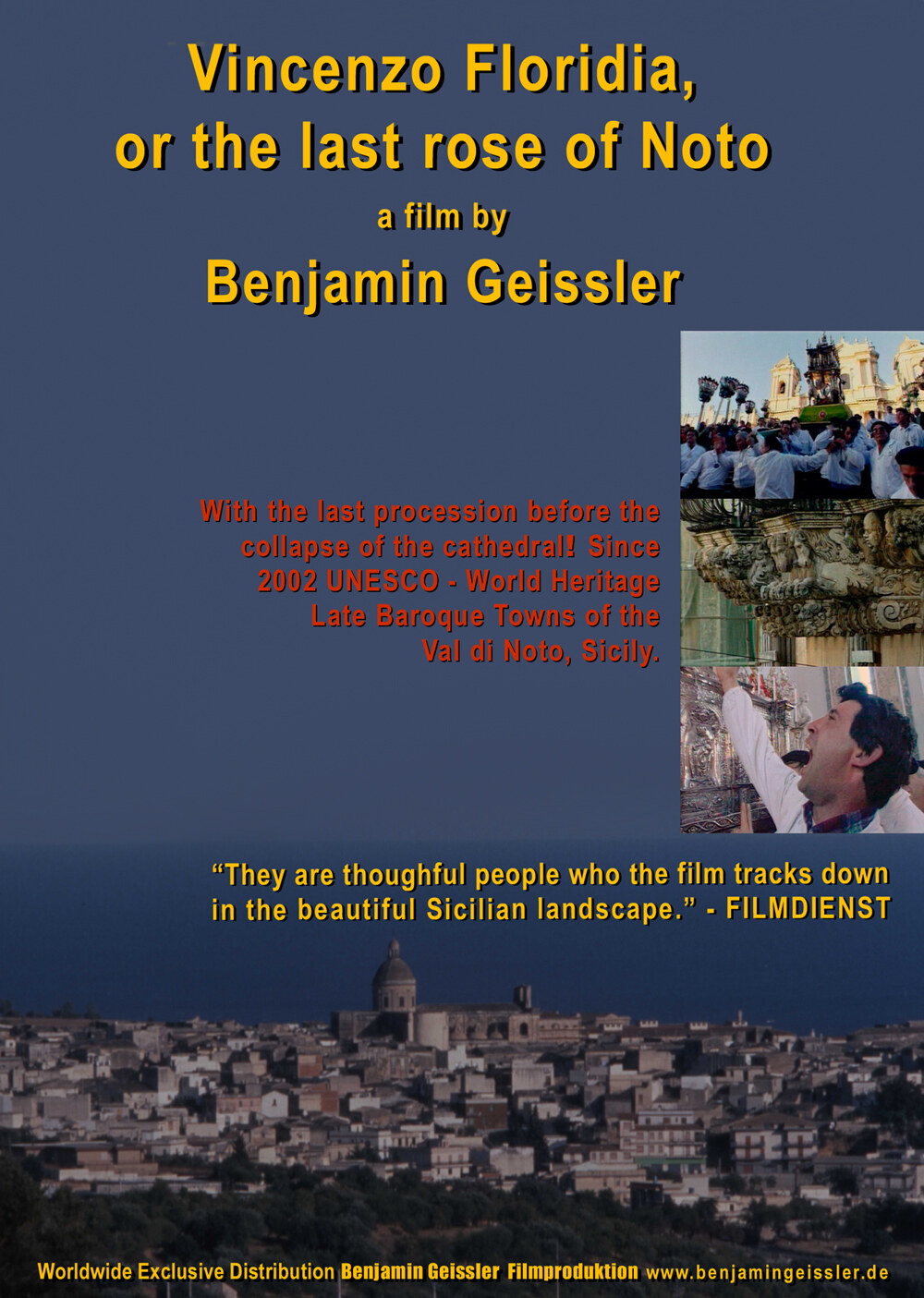
The camera also preserves images that have themselves become history: Noto Cathedral before its collapse in March 1996, and celebrations honouring the city’s patron saint, San Corrado.
The result is a film about the tension between roots and new beginnings, the search for a self-determined life – and what it means to remain true to oneself.
In this way, the film brings together a personal story of return and a portrait of Sicily between tradition, technological change and social transformation.
People
Vincenzo Floridia’s return to Noto brings us close to people whose friendships and life stories extend far beyond Sicily. Among them is his childhood friend, the confectioner Corrado Assenza, who sees personal integrity and the freedom to make one’s own choices as an answer to the Mafia’s hold on society: being rather than appearances.
The photographer Giuseppe Leone, who collaborated with writers including Leonardo Sciascia, Gesualdo Bufalino and Vincenzo Consolo, discovers the vitality and cultural character of his homeland in seemingly incidental moments of everyday life. He also wonders what will survive of that identity amid social change.
Pippo Gurrieri, a railway worker and journalist, met Vincenzo while they were both living in Piedmont. Their friendship links personal memories with searching questions about Sicily’s economic future and the effects of industrial pollution.
Together with Vincenzo’s family, friends and fellow railway workers, they create a many-voiced portrait of people who love their homeland without concealing its contradictions.
Filming Locations
Sicily · Noto · Syracuse · Ragusa · Catania
Filming took place between February and July 1995 in southeastern Sicily. Railway lines, stations and workshops, alongside the streets and squares of Noto, form the film’s settings.
Among the settings are the celebrations honouring San Corrado in Noto.
Crew & Production
Featuring: Vincenzo Floridia, Carlo Assenza, Corrado Assenza, Pippo Gurrieri, Giuseppe Leone, Vincenzo Cimò, Francesco Floridia, Salvatrice Leone, Laura Bufalino and others.
Concept, direction, editing: Benjamin Geissler · Cinematography: Giancarlo Pancaldi, Benjamin Geissler · Sound: Andrea Masciocchi, Peter Stockhaus · Assistant director: Nadia Malverti · Still photography: Walther Dal Pesco · Sound mix: Michael Bohle · Production manager: Peter Stockhaus · RAITRE editor: Giovanni Tantillo.
With passages from Elio Vittorini’s Conversation in Sicily. A Benjamin Geissler Filmproduktion production, supported by the Lower Saxony Film Fund and RAITRE. © 1995 Benjamin Geissler Filmproduktion.
Festivals & Screenings
Italian national premiere
23 March 1996 – Cantina Sperimentale, Noto (Sicily). Two screenings at 5:30 p.m. and 8:00 p.m.
Television broadcast
21 July 1996, 12:30 p.m. – RAITRE (Italy).
Festivals and cinema screenings
In 1996 the film was presented, among others, at the Tage des unabhängigen Films in Osnabrück, Inventur 3 – Filmschau Niedersachsen in Göttingen and Der neue Heimatfilm in Freistadt (Austria).
In January 1997, cinema screenings followed in Germany, including Hamburg (Metropolis), Berlin (Babylon) and Bremen (Kino 46 / Kommunalkino).
Press & Audience Responses
A portrait of a generation of still-young Sicilians who, while living away from home, decided to return despite the lack of prospects.
Lexikon des internationalen Films (English translation)They are thoughtful people whom the film discovers amid Sicily’s fascinatingly beautiful landscape.
FILMDIENST (English translation)Where roses will no longer grow at the railway station, there is nevertheless a world that continues to pulse and wants to live – amid all its contradictions.
Pippo Gurrieri, Sicilia Libertaria (English translation)Audience response following the RAITRE broadcast of 21 July 1996
“I was deeply moved by your story and that of your friends, who returned to Sicily after trying to live and work in other cities.”
“What he (Corrado Assenza) said about his attitude towards the ‘Mafia problem’ was, in my opinion, the most intelligent thing I have heard in all the talk about the Mafia.”
“I believe that only in this way, by being profoundly alien to the Mafia mentality and living accordingly, can an equally profound civic mentality emerge; that is what all of us, without distinction, need.”
Sara T. (58, factory worker, Bologna)
Letter from a viewer following the RAITRE broadcast on 21 July 1996.