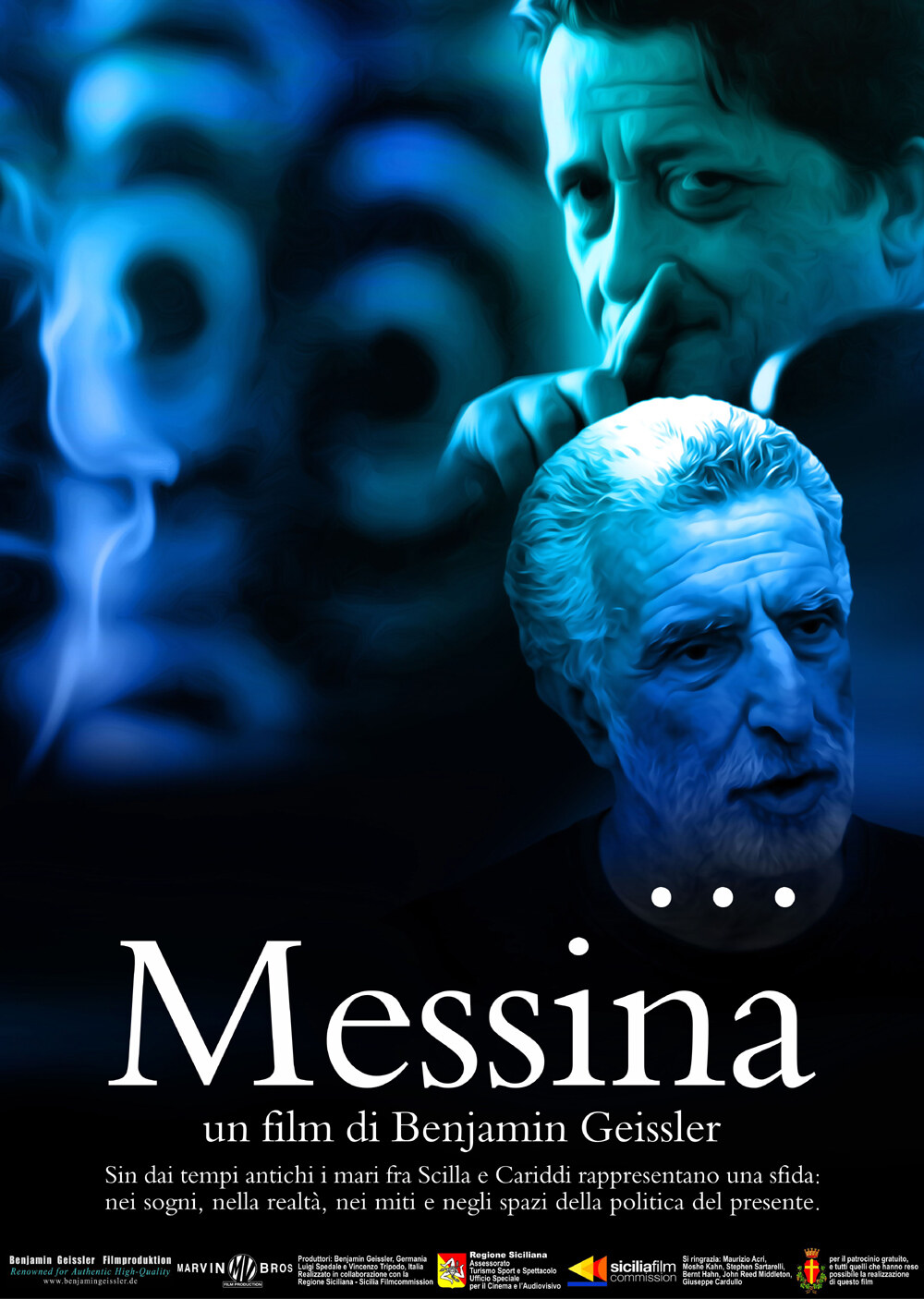
... Messina
FILM & SYNOPSIS
… Messina is a contemplative yet critical cinematic journey into one of Europe’s most important crossroads. Since antiquity, the waters between Scylla and Charybdis have challenged humanity. They shape the realities, dreams, myths and political spaces of the present. Over 60 shooting days between 2013 and 2015, Benjamin Geissler observed the living conditions of this Sicilian city from different perspectives, creating an ambivalent portrait of its human, historical and symbolic dimensions.
A central focus is Stefano D’Arrigo’s novel Horcynus Orca. Forty years after its first publication, Moshe Kahn masterfully translated the work into German for S. Fischer Verlag. The epic is regarded as one of the last great novels of the twentieth century. Kahn received the German-Italian Translation Prize in 2015. Passages from the novel, conversations with the translator and impressions from Sicilian readers intertwine with the voices of local politicians and citizens from different social backgrounds.
At the same time, the film essay examines the flashpoints of local politics. For decades, the city has been shaken by fierce debates over a bridge across the Strait of Messina, a controversy that continues today. This multi-billion-euro megaproject threatens to divert resources from other priorities: climate protection, urgently needed local infrastructure and a migration policy respectful of human rights. Residents fear the destruction of their homeland and ecological disasters in a region at high seismic risk.
Against this backdrop, Renato Accorinti was elected mayor in June 2013. Supported by Cambiamo Messina dal basso, his administration opposed the bridge project and confronted regional decline and growing social tensions amid the arrival of refugees and migrants from North Africa. The film follows an attempt to establish democratic participation, social responsibility and political renewal against entrenched power structures.
Sixty years after the historic Messina Conference, the film turns to the crises and contradictions of the European Union at its periphery. The region reveals how bureaucracy and complex regulations can paralyse Europe at every administrative level. The turbulent waters between Scylla and Charybdis become a powerful metaphor for “translation”: from one language to another, from one culture to another, and towards the urgent challenges of our shared European future.
Back to top ↑Background
Horcynus Orca – Literature as a Key to Reality
Both the story of how Stefano D’Arrigo’s monumental novel Horcynus Orca came into being and the story of its German translation are an odyssey.
The novel’s extraordinary language, neologisms, dialects and multiple layers of meaning made its translation into German a remarkable literary challenge.
Literary source: Horcynus Orca by Stefano D’Arrigo, original edition Rizzoli, 1975 · German translation: Moshe Kahn, S. Fischer Verlag, 2015 · Other translations: Stephen Sartarelli (English), Monique Baccelli and Antonio Werli (French), Miguel Ángel Cuevas (Spanish).
The novel’s linguistic power and its world between myth, sea and history are an essential starting point for the film. Excerpts, conversations with the translator and impressions from Sicilian readers meet observations of present-day Messina.
Translation becomes a central motif: between literature and reality, past and present, different cultures and political ideas. The strait between Scylla and Charybdis becomes a symbol of both the difficulties and the possibilities of mutual understanding.
Politics Between Hope and Resistance
After decades of party-political power structures, corruption, Mafia influence and disputed public contracts, Messina was temporarily placed under extraordinary administration. Renato Accorinti’s election as mayor in June 2013 raised hopes of a political new beginning.
Accorinti had long campaigned for human rights, the environment, non-violence and the common good. His movement sought direct citizen participation in shaping the city. The film observes this experiment without overlooking its contradictions and practical difficulties.
The Bridge Across the Strait of Messina
The controversial megaproject exemplifies the conflict between centrally directed promises of development and local needs. In this earthquake-prone region, environmental consequences, infrastructure, public expenditure and democratic participation are at stake.
Messina and Europe
The 1955 Messina Conference was an important step towards the Treaties of Rome and European integration. Sixty years later, the film explores the contradictions between European ideals and living conditions at the Union’s southern borders.
The Cinematic Approach
Benjamin Geissler combines long-term observation, conversations, literary quotations, historical references and images of the city into an essayistic narrative. The personal and social, concrete and symbolic are brought into dialogue without reducing reality to a single political thesis.
Back to top ↑Protagonists
Literature, Science and Culture: Moshe Kahn – literary translator, Berlin · Ivana Parisi – sociologist, Messina · Pier Paolo Zampieri – sociologist, Messina · Prof. Gaetano Giunta – physicist and president of the Horcynus Orca Foundation · Prof. Girolamo Lo Verso – psychoanalyst, Palermo · Prof. Paolo Jedlowski – sociologist and philosopher, University of Calabria · Salvo Trimarchi – bookseller · Stefano Lanuzza – writer, Florence · Gigi Spedale – cultural producer.
Politics and City Administration: Renato Accorinti – mayor of Messina · Antonio Le Donne – city manager · Luigi Sturniolo – local politician · Prof. Guido Signorino – deputy mayor and economist · Alessio Ciacci – manager and liquidator of Messinaambiente · Prof. Antonio Maria Perna – councillor for culture, sociologist and economist · Gaetano Cacciola – mobility, energy, innovation and municipal police · Pier Ferdinando Casini – politician, chairman of the Italian Senate’s Foreign Affairs Committee.
Citizens and Civic Initiatives: Pietro Cirone · Giovanni Rotondo · Anna Monastro · Clelia Marano · Mohammed Refaat · Mohammed Aguennouz · Massimo Camarata · Filomena Romeo · Prof. Lucia Risicato · Giovanni Forestieri · Cecilia Caccamo · Vincenzo Floridia · Paolo Pagani · Mario, reader of Horcynus Orca.
Other Participants and Observed Groups: Vittorio Condurso and Giuseppe Spadaro of the Lega Navale Italiana · Antonio Tavilla and the bearers of the Madonna della Lettera procession · ATM bus drivers · residents of Giostra Alta · a young fisherman from Grotte · demonstrators · members of the Islamic Cultural Centre · school occupiers · migrants · rowers · University Choir of Messina performing Beethoven’s Ode to Joy · Benjamin Geissler and many others.
Back to top ↑Filming Locations
Messina and the Province of Messina, Sicily: Neighbourhoods, public institutions, coastal landscapes, sites of political conflict and everyday life.
Reggio Calabria and its Province, Calabria: The opposite shore of the strait and other locations in the region.
Berlin: Filming related to the German translation of Horcynus Orca.
Hamburg: Additional filming and production locations.
Back to top ↑Crew & Production
Concept, screenplay, direction, cinematography, editing and special effects: Benjamin Geissler
Sound: Patrizio Celano, Gigi Spedale, Benjamin Geissler
Producers: Benjamin Geissler (Germany), Gigi Spedale and Vincenzo Tripodo (Italy)
Production: Benjamin Geissler Filmproduktion, Germany, and MARVIN BROS Film Production s.r.l., Italy
Countries and year: Germany / Italy, 2016
Literary excerpts: Horcynus Orca by Stefano D’Arrigo
Read by: John Reed Middleton
Subtitles: John Reed Middleton
Back to top ↑Screenings
7 October 2016 – Messina, Italy: Film screening at the Sala Visconti as part of Sabir Fest.
2017 – International presentation of the film trailer: The trailer was presented internationally online to mark the 60th anniversary of the Treaties of Rome and the G7 and G20 summits.
Back to top ↑Press and Film Reviews
An impressive story; exactly the kind of European
film I think is needed right now: concrete, local,
encouraging, which doesn't just invoke values but
develops them out of the material.
Martin Hagemann, Film Producer, Professor at the
Filmuniversität Babelsberg KONRAD WOLF
I watched the film immediately and it moved me deeply.
This is the true fiction that also lives in literature.
Not to mention the great, very great D'Arrigo.
Claudio Magris, Erasmus Prize winner, Peace Prize
of the German Book Trade
I have finally seen your film... its images have
given new contours to the fantastic world of D'Arrigo.
[...] I also had the impression that the rhythm of
your film translates into a new dimension the strong
and often dominant prosaic rhythm of the book.
Hans Ulrich Gumbrecht, Professor of Literature and
Comparative Literature, Stanford University,
California, USA
Film Review – Mosè Previti
... Messina is a dense documentary—a complex and profound intellectual reflection—that delves with great precision into the inextricable recent history of the city of Messina. Benjamin Geissler handles this dense, dark subject matter with clinical precision and immense love.
The Hamburg-based director delves into the Peloritan labyrinth, following the twisted thread of Stefano D’Arrigo’s Horcynus Orca, on a long journey that serves as a complex fresco of our recent history.
In his documentary, Geissler highlights three crucial points, and he does so in an educational and clear manner; despite the complexity of his language, these points strike home with precision to the stunned residents of Messina.
1) Horcynus Orca is one of the greatest novels of post-World War II European literature. Not only for its extraordinary formal exploration, but above all for the incredibly visceral way in which it tackles the defining theme of our era: power and its survival.
2) Messina is a frontier, a margin—to use a term dear to sociologist Pier Paolo Zampieri—for gauging the state of the continent, and perhaps of the world.
3) It is possible to save ourselves from power and from the obstinacy with which it seeks to impose its cruel senselessness. We can save ourselves through dialogue, through slow, thoughtful reflection, and, of course, through beauty.
Benny Geissler discovered a systemic anomaly in Messina and saw Renato Accorinti as a symbol of a different kind, but his book is not a hagiography; there is no glorification of the “barefoot mayor.” With great clarity, Geissler examined the origins, the course, and the fragility of his political career, as well as the difficulties he faced in governing.
This documentary is a tremendous gift; this project, carried out over three years in complete solitude, cannot be reduced to 90 minutes, and I find it offensive to single out its length, as has been done. Because its duration cannot be condensed into a brief span, the effort must sustain the pleasure. Of course, as with any long run, the pace isn’t always the same, and the scenery isn’t always captivating, but the end result is truly immense. I don’t know if the people of Messina will understand the value of this work, which should be displayed in public squares and schools, yet its very existence is a source of comfort; its message affirms the resilience and dignity of a small community of free, alert, and attentive citizens who, regardless of their affiliations, know that Messina—like Sicily—is a metaphor for the world, and that here, as elsewhere, the slow steps toward salvation can be taken.
Mosè Previti